Mobile workbenches and service carts live a double life: they are furniture when parked, and cargo when moved. Drawer slides on these units have to resist the forces of rolling over thresholds and uneven floors, then still open smoothly and hold a loaded drawer at full extension.
The movement problem
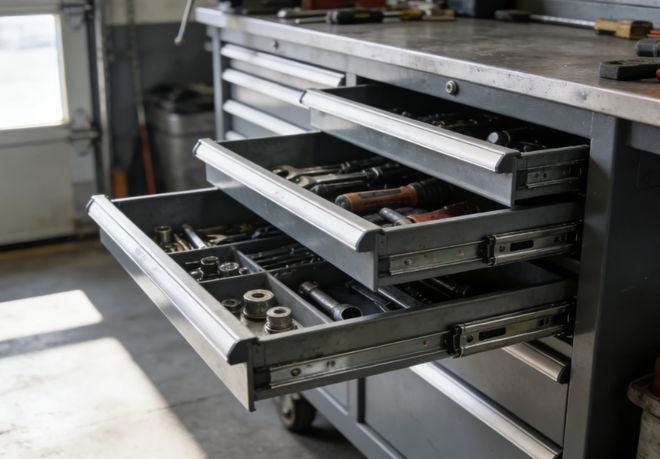
When a cart rolls, inertia tries to slide drawers open. The fix is a lock-in or lock-out slide on every drawer — a spring detent in the closed position is usually enough for most carts. For heavy or tall carts, combine the slide detent with a central locking bar that the cart’s own locking system operates.
Loads that move
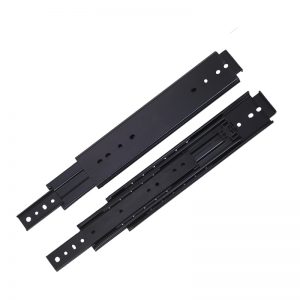
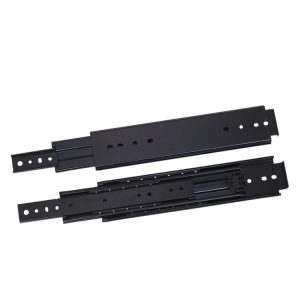
A service cart drawer carries tools, parts and power equipment — typically 30–60 kg per drawer when fully loaded. Specify the pair rating with a 20% margin over the heaviest drawer, because rolling loads add dynamic stress the static rating does not include. Three-section ball bearing slides with 100% extension are the standard choice so the drawer is fully accessible at the worksite.
Vibration and impact
Rolling carts transmit shock through the rails. Rail thickness (1.8 mm minimum for mobile duty) and captive ball retainers make the difference between a slide that stays smooth and one that develops play. If the cart will run over thresholds or loading ramps, mention it in the RFQ — we will steer you to the heavier rail section.
Verify before you standardize
Run the loaded cycle test on a sample with the cart fully loaded and moving — static bench testing misses exactly the failure mode that matters. Cycle life and load capacity testing can be scheduled against your own cart design, with the report attached to the shipment for your QC file.
Mobile storage fails in a specific way: the drawer works perfectly on the bench and drifts open on the floor. The fix is not a heavier slide but the right detent and rail section for moving loads. If your carts cross thresholds or run on ramps, say so at specification time — it changes the rail thickness and the lock-in requirement, and it is far cheaper to specify correctly than to retrofit locking after the first field complaint.