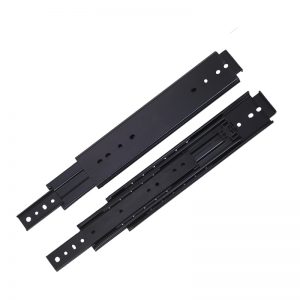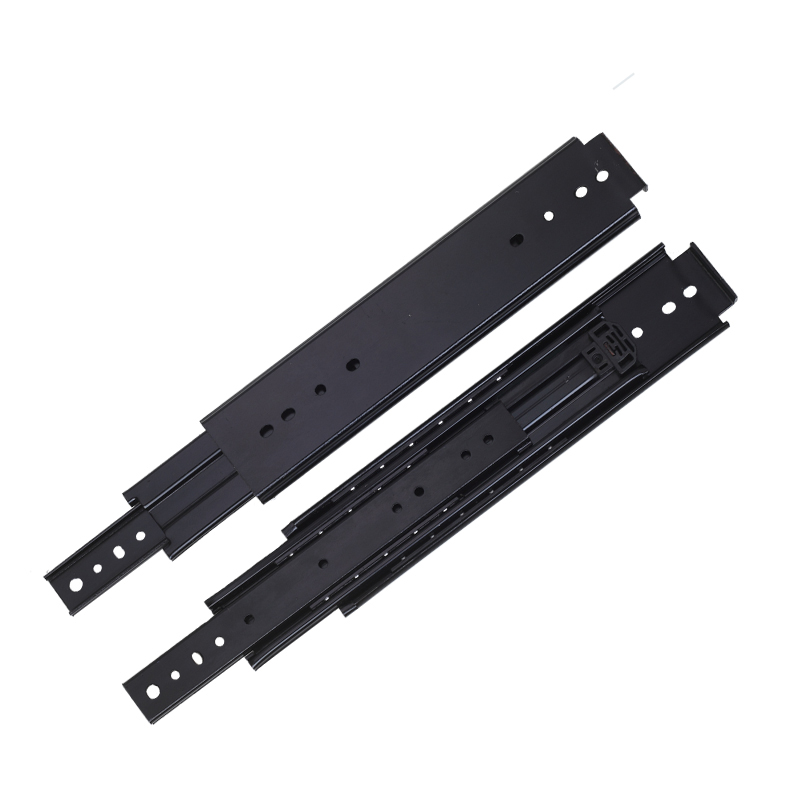
The tall pantry pull-out is the highest-value drawer in many kitchens — a full-height frame that rolls out to expose every shelf. Because it is tall, wide and heavily loaded, it is also the hardest job a slide can get in a home. The spec has to cover more than the load number.
Full extension is non-negotiable
A pantry frame is only useful when its back rows are reachable, which means 100% travel — three-section slides, not the two-section “3/4 extension” commonly used elsewhere. Confirm the extension percentage in the quotation; the difference is immediately visible in daily use.
Lateral stability: the real failure mode
A tall frame loaded with jars rocks side to side when extended. Slides rated purely on vertical load can still feel wobbly. Look for rails with thicker sections and check lateral rigidity on the sample — open the drawer fully loaded and push sideways. The slide spec sheet should state both vertical load and the travel, and a good supplier will confirm stability on the actual frame height you plan.
Weight: the 40 kg pantry
Fully loaded, a tall pantry pull-out commonly reaches 35–45 kg. The weight concentrates on the two slides at full extension, so pair ratings of 45–65 kg are the practical range — always with the frame weight included in the calculation. If the frame holds heavier appliances or bulk storage, step up a class and confirm the rail thickness in writing.
Soft-close that matches the weight
Tall frames slam shut with serious momentum. A hydraulic soft-close damper sized for the actual weight is essential — under-damped soft-close on a heavy pantry does more harm than no damper, because it lets the frame accelerate before catching. Specify soft-close capacity matching your loaded weight.
Pantry pull-outs are the one drawer where buyers over-specify load and under-specify stability. A tall frame loaded to 40 kg at full extension is a lateral stability problem as much as a load problem, so the sample test should push sideways, not just down. Confirm travel, damping and rigidity on the real frame height, and the pantry becomes the fixture the kitchen is built around instead of the one that gets replaced first.