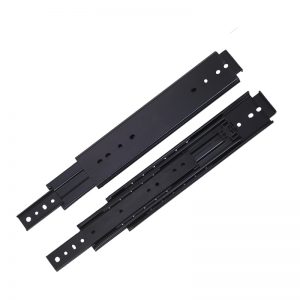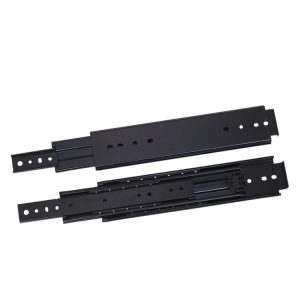
A dining-table builder needed a repeatable slide solution for an extension-table mechanism where every leaf has to travel smoothly and lock into the closed position. The slide has to sit inside the table frame rail, so the frame inner width drives the slide length and bracket pattern.
What we reviewed
We confirmed the extension travel required (single-leaf or two-leaf extension), the frame inner width, the operating environment, and the finish before production. Slides were matched to the frame rail and confirmed against the approved drawing or sample.
How it was verified
Travel geometry, bracket pattern and finish were checked against the approved drawing before release. The slide was function-tested at full extension under load to confirm smooth travel and the closed-position lock.
Result
The configuration is now documented as a reference layout for similar dining-table and extension-furniture projects, with quantities and lead time confirmed per order.
Travel and geometry
The travel of the extension leaf determines the slide travel. Single-leaf tables need a single slide; two-leaf tables need both leaves to travel in unison. The slide geometry must match the table frame geometry — the slide sits inside the frame rail, so the frame inner width sets the slide length and bracket pattern.
Confirm the extension travel required, the frame inner width and the finish before production. Slides are confirmed against the approved drawing or sample, with lead time and MOQ confirmed per order.
Project requirements
Confirm the extension travel required (single-leaf or two-leaf extension), the tabletop weight, and the installation envelope. The slide must travel smoothly under the full tabletop load and hold position at the extension midpoint.
For two-leaf extension tables, specify the travel of each leaf independently and confirm the slide travel matches the leaf travel.
Installation & sizing notes
The slide must be mounted to a structural member of the table frame, not to the tabletop itself. Confirm the frame geometry allows the slide to travel its full length without binding.
Slide length is typically selected so that the slide travel equals the leaf travel. For two-leaf extension tables, both leaves must travel in unison; verify the bracket geometry allows this.